

Retirement Investing: Why Traditional Investment Strategies Don’t Guarantee Stability, and How to Build Your Own Retirement Fund with Stocks
The prevailing approach to retirement investing today suggests putting all your savings into various ETFs. The main argument is that it’s difficult to beat the market, and there’s some logic to that. But there’s a nuance that isn’t often discussed with individual investors. With this approach, they won’t be able to achieve the main goal - securing their retirement!
Which category of investors do you fall into?
We can identify five categories of investors. Four of them are happy but few in number, while one is numerous but not very happy.
Let’s start with the “lucky” categories of investors:
- They have significant initial capital, enough to cover the expenses of one person or an entire family for about 10 years while maintaining their usual standard of living.
- Start investing early - at ages 18-20 - and consistently set aside at least a quarter of your income for this purpose.
- Their income exceeds their expenses to such an extent that they can allocate at least 40% of their current earnings or business profits to investments.
- They have personal non-investment income that outpaces inflation by at least 3 per year. This allows investors to consistently and significantly grow their investments in their investment fund, even in real terms (adjusted for inflation).
If you fall into one of these four fortunate categories of investors, then passive index investing is a perfectly reasonable path for you.
If you cannot classify yourself as belonging to at least one of these groups, then you fall into the fifth category - ordinary retail investors. This is the largest category by far, significantly outnumbering all the “lucky” categories combined.
Individual Investors
Ordinary retail investors face a serious problem. They will not be able to achieve financial independence within a reasonable timeframe if they follow the currently popular path of passive index investing. In most cases, they will never achieve financial independence.
The calculations we presented in our book “18 Steps to Financial Freedom” show that if you consistently invest 15% of your income in a traditional investment portfolio, it will take 50 years before you can receive investment income sufficient to maintain your accustomed lifestyle in retirement.
If you start investing at age 30 and set aside 15% of your income, you won’t be able to enjoy the fruits of your investments until you’re 80. But what if you don’t start until you’re 40? This serious problem keeps many people from investing at all.
We believe, however, that this unfortunate circumstance is not a reason to give up on investing altogether, but rather a reason to rethink your approach.
How to Significantly Increase Your Portfolio’s Returns
If the average annual real return increases to 8% per year (up to 11% in nominal terms), financial independence is achieved in 25 years rather than 50.
And not at age 80, but at age 55, an investor who started from scratch at age 30 can begin living exclusively on investment income without having to scale back their spending habits or preferences. It sounds impressive, but how can this be achieved? To reach this goal, you’ll have to rethink many things: in some cases, change your approach; in others, let go of assumptions that once seemed obvious and correct, namely:
- from geographic diversification;
- from including bonds in the portfolio,
- from including gold in the portfolio.
However, even these significant deviations from the classic approach do not solve the problem of achieving a real average annual return of 8%. Even a portfolio composed entirely of the VOO ETF (90%) and cash (10%), without any bonds or gold, yields the investor approximately 5.75% after adjusting for inflation - and that is not enough.
Active Investing
To achieve the desired result, we recommend turning to active investing (stock picking). This involves selecting and holding, over the long term, shares of companies with the best economic performance, provided their shares are trading at a reasonable price. The effectiveness of this approach has been proven by the track records of great investors such as B. Graham, W. Buffett, J. Templeton, F. Fisher, P. Lynch, and others.
We suggest adding a group of assets called “individual stocks” to your portfolio. In the book *18 Steps to Financial Freedom*, we clearly demonstrate that investments in this asset class yield, by the most conservative estimates, 11% per year after adjusting for inflation.
This allows you to structure your portfolio as follows:
- 40% - VOO ETF;
- 50% - individual stocks;
- 10% - cash.
The return on such a portfolio will be approximately 8% per year after adjusting for inflation - exactly what you need for a happy retirement!
How to Approach Stock Selection
But how do you select good stocks that will yield an average annual return of at least 11%? As Graham and Buffett taught, to do this, you need to study the companies’ fundamental economic indicators:
- revenue,
- profit,
- P/E,
- marginality,
- the proportion of debt in the company’s assets.
We need to look at how these metrics have changed over the past 10 years. Are they rising or falling? If they’re rising, at what rate, and how sustainable is that growth?
There are various ways to approach this task. For example, you can screen stocks that, for one reason or another, have caught your attention. Or you can take a more systematic approach - examine the entire U.S. market, which consists of about 10,000 stocks, and run them through a series of filters based on each metric.
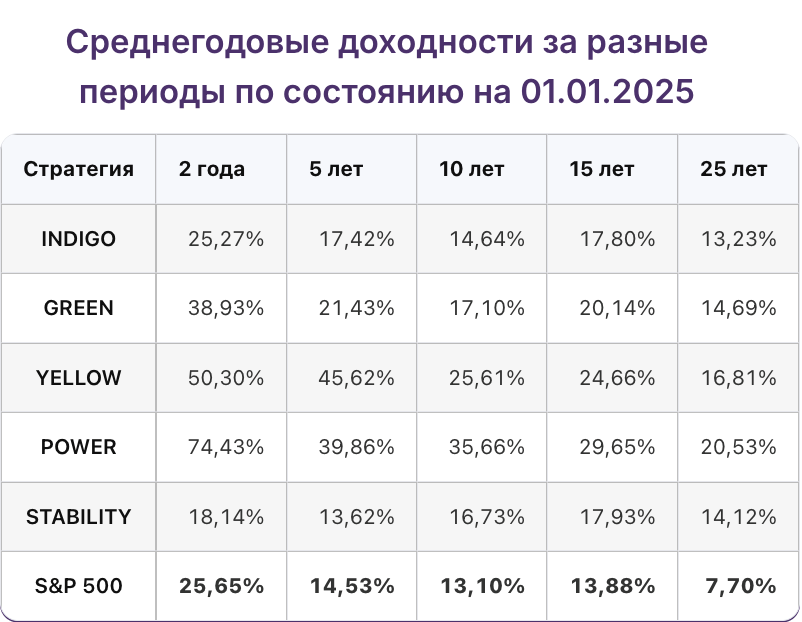
This is, of course, a large-scale undertaking. At AVI Stocks, we have tackled this task many times. We examined how portfolios of stocks selected based on fundamental indicators perform over a 25-year horizon. As a result, we identified several sets of parameters, which we termed “strategies.” We have now developed five growth strategies and one growth strategy with reduced volatility (STABILITY). Below are their returns over various time periods.
In addition to testing the performance of individual stock selection strategies over the past 25 years, 18 months ago we purchased a portfolio of stocks based on each of these strategies and are maintaining a comprehensive track record for them.
Below are the summary results. These are growth stocks that we have been tracking for 18 months:
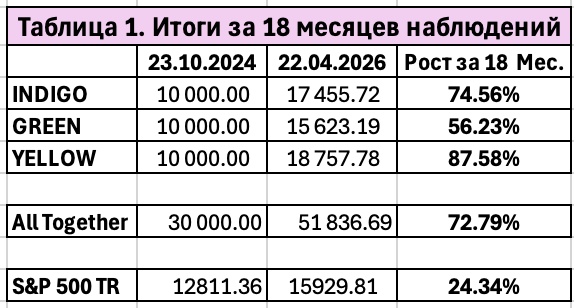
Of course, a year and a half is a very short period for long-term investing. But we believe that this relatively short track record, combined with backtesting over various time intervals up to 25 years, shows that the idea of turning to active investing (stock picking) is quite viable and can yield good results with a systematic approach and high-quality analysis. And it is precisely this approach that can lead you to a decent, secure retirement.
This article was first published on Finversia on May 13, 2026.
Discussion on Telegram
No comments yet. Be the first!
Sign in with Telegram. Your comment will appear under the post in the channel.