


Diversification or Farce?
Diversification has long been considered almost a sacred concept in investing.
The classic approach to portfolio construction looks like this:
- Don’t put all your eggs in one basket.
- Hold stocks, bonds, gold, and real estate.
- Allocate capital across countries and sectors.
Theoretically, it’s all true. A mix of different assets can indeed reduce risk. But retail investors wonder: Does diversification always work, or does it sometimes merely create a false sense of security while simultaneously reducing returns?
The classical approach has at least two practical problems.
A balanced portfolio does not always meet an investor’s goals and typically offers moderate returns. For an investor building capital from scratch, this may not be enough. Simply put, an overly cautious strategy may seem safe on paper, but it does little to help achieve financial goals.
It’s also worth noting that the market is constantly changing. Historical correlations between assets are not permanent. What was considered a safe-haven asset in one market cycle may cease to fulfill that function in another. Therefore, it is useful to periodically re-evaluate even the most popular investment ideas based on data.
A Short Test on Diversification
For the analysis, we selected liquid ETFs with a long trading history representing various asset classes:
- U.S. market - VOO;
- global market - VT;
- gold - GLD;
- Industrial sector - VIS;
- consumer sector - VDC;
- utility services - VPU;
- Real estate - VNQ;
- Technology - VGT;
- short-term Treasury securities / cash substitute - BIL.
Three indicators were then compared:
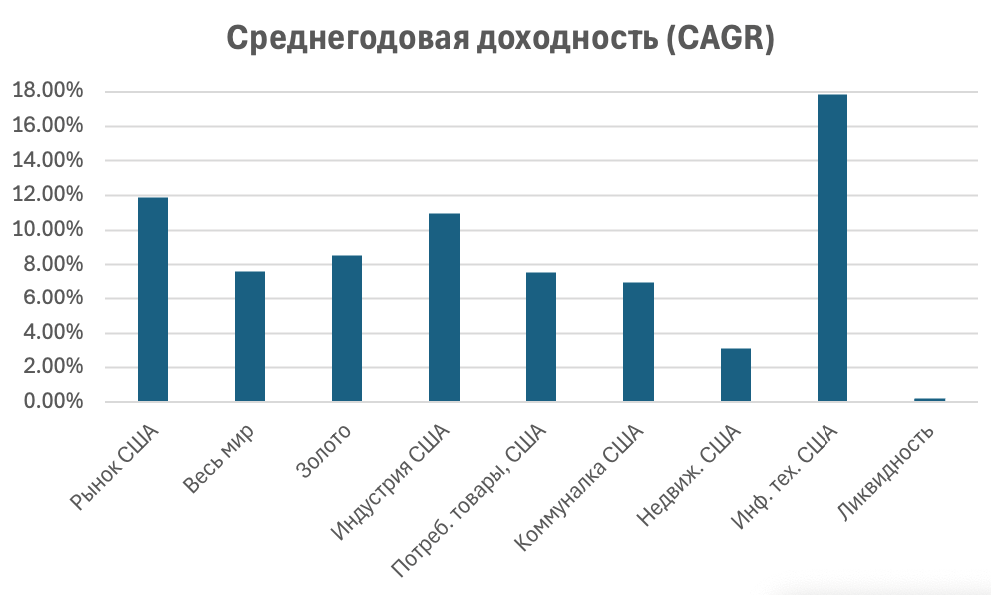
1. Returns over the past 15 years.
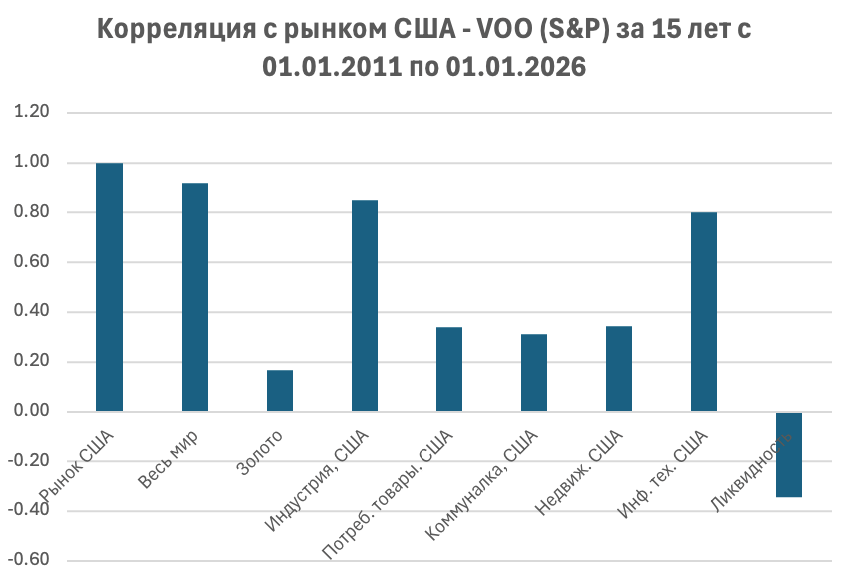
2. Correlation with the U.S. market.
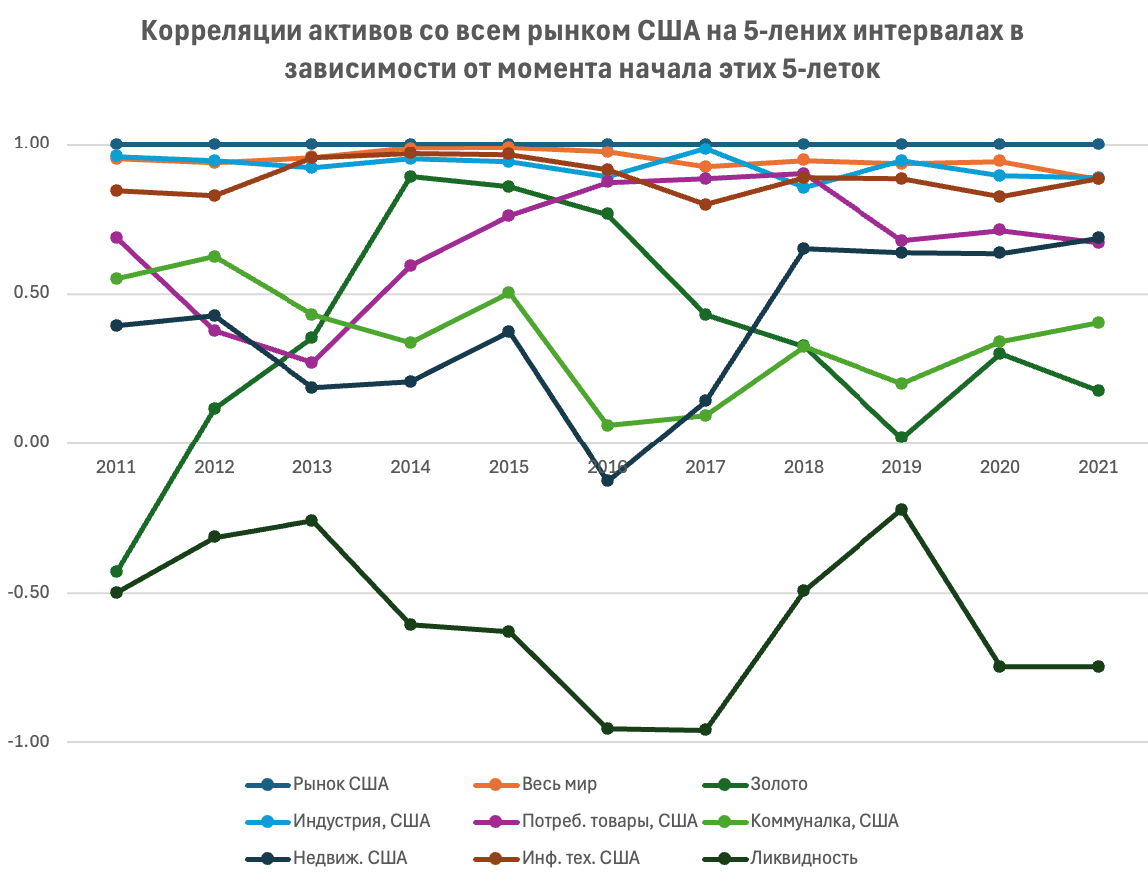
3. Changes in correlations over 5-year moving intervals.
What the Data Revealed
1. Three Types of Assets
Based on the nature of their correlation with the U.S. market, the instruments under study can be broadly divided into three categories.
The first group - consistently high correlation:
- global market;
- U.S. industrial sector;
- U.S. technology sector.
Such assets may be useful for capital growth, but they are poorly suited to serve as a protective component of a portfolio.
The second group is variable correlation:
- utility services;
- consumer sector;
- gold;
- real estate.
In some time frames, these assets demonstrated protective properties; in others, they moved in tandem with the market. Their role in the portfolio cannot be considered stable.
The third group is stable protection. Among the assets studied, liquidity demonstrated the most stable protective properties. The correlation with the U.S. market remained negative across all time intervals examined.
2. The problem is that during a crisis, the world often falls along with the U.S.
Over the 15-year period under review, the global market posted an average annual return of 7.60%, while the U.S. market returned 11.91%. However, investors do not achieve full portfolio protection through geographic diversification alone. The correlation between the global market and the U.S. market remains high, ranging from 0.88 to 0.99 across various time intervals.
In practice, this means that a decline in the U.S. market is often accompanied by a drop in global markets. The 2008 mortgage crisis served as a clear example of how a domestic problem in the U.S. quickly turned into a global one.
3. The technology sector proved to be particularly strong
Technology companies have shown a high correlation with the U.S. market, but at the same time, significantly higher returns. This raises a practical question: Is a broad index always the optimal foundation for a portfolio if a specific sector consistently outperforms over the long term? There is no single answer, but this question deserves consideration.
4. Gold and real estate exhibit volatile behavior
These assets are traditionally considered defensive. However, they have exhibited different characteristics over various time periods. In some periods, they did indeed reduce portfolio risk somewhat, while in others, they moved in tandem with the market. Consequently, protection here is not guaranteed simply by the fact of owning the asset.
5. The most boring asset in a portfolio often turns out to be the most useful - plain old cash
Short-term Treasury securities offer modest returns. They are not a tool for aggressive capital growth. But it is precisely liquidity that often proves to be the most useful element of a portfolio, because it:
- preserves capital;
- reduces overall volatility;
- It provides an opportunity to buy assets during market pullbacks;
- It increases an investor’s flexibility.
From this, we can conclude that sometimes the most boring asset turns out to be the most valuable.
* * *
The problem isn’t diversification itself, but mechanical diversification - when an investor simply buys many different assets without asking themselves the key questions:
- How do they perform during a crisis?
- To what extent do they depend on one another?
- What Really Protects Capital?
- What drives growth?
- What merely creates the appearance of reliability?
Correlation alone does not provide a complete answer. High correlation does not always mean a poor asset, and low correlation does not always mean a good one. What matters more is the combination of three factors: return, stability of performance, and role in the portfolio. Perhaps the right question is phrased differently. Not “How diversified is my portfolio?” but “Which portfolio components serve different functions?” These could include:
- capital growth;
- Protection during a crisis;
- liquidity reserve;
- inflation protection;
- source of cash flow.
Diversification alone does not make a portfolio high-quality. What matters is not the number of instruments, but their purpose. Some assets are meant to grow, others to protect capital, and still others to provide liquidity. When an investor understands this distinction, diversification becomes a tool; when they do not, it turns into a farce.
This article was first published on Finversia on May 12, 2026.